
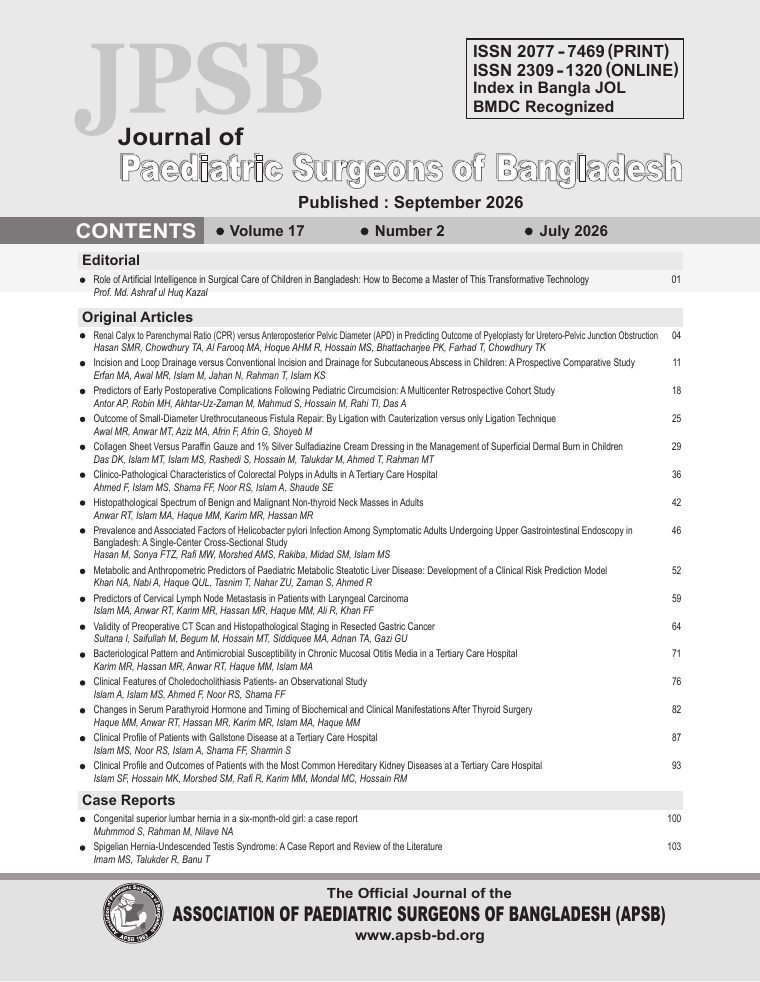
Collagen Sheet Versus Paraffin Gauze and 1% Silver Sulfadiazine Cream Dressing in the Management of Superficial Dermal Burn in Children
Authors
Keywords
Abstract
Background: Burn injuries globally challenge both developed and developing nations. Management focuses on achieving swift, complete healing and restoring skin texture and color. However, selecting the most suitable treatment method among diverse options can be daunting. This study assessed the outcomes of collagen sheet dressing compared to paraffin gauze and 1% silver sulfadiazine (SSD) cream dressing for superficial dermal burns in children. Objective: To compare the outcomes between collagen sheet dressing with paraffin gauze and 1% SSD cream dressing in superficial dermal burn in children. Methods: This 18-month quasi-experimental study at the Department of Paediatric Surgery, Sylhet MAG Osmani Medical College Hospital, included 110 paediatric patients (≤12 years) with superficial dermal burns (≤15% of total body surface area) after obtaining ethical approval and informed consent. Patients were divided into two groups: Group-A received collagen sheet dressing (n=55), and Group-B received paraffin gauze and 1% SSD cream dressing (n=55). Data were collected using separate case record forms and analyzed using SPSS 26.0. Results: Mean age of the study population was 44.72±33.84 (months) with an almost equal male-to-female ratio. Maximum study patients had multiple burns injury (58.2%) and mostly due to moist heat (87.3%). Both groups were similar in terms of age, gender, site, cause and size of the burn (p>0.05). Group-A patients had significantly shorter healing time (11.87±5.04 vs 13.11±4.94 days) and lesser hospital stay (3.89±2.12 vs 8.20±4.71 days) compared to group-B patients. Three patients (5.5%) from group-A had developed burn wound infection, while in group-B, eight patients (14.5%) had burn wound infection. The total cost of dressing materials was found to be similar between groups (1654.73±914.96 taka in group-A and 1454.55±816.19 taka in group-B, p>0.05). Less frequent dressing changes in collagen sheet dressing (1.71 ± 1.88 vs 3.64 ± 1.27), p<0.05. Conclusion: This study highlights the clear advantages of collagen dressing over paraffin gauze and 1% SSD, including easier application and removal, shorter healing time and reduced hospital stay. However, further larger scale study is recommended.
Journal of Paediatric Surgeons of Bangladesh (2026) Vol. 17 (2): 29–35