
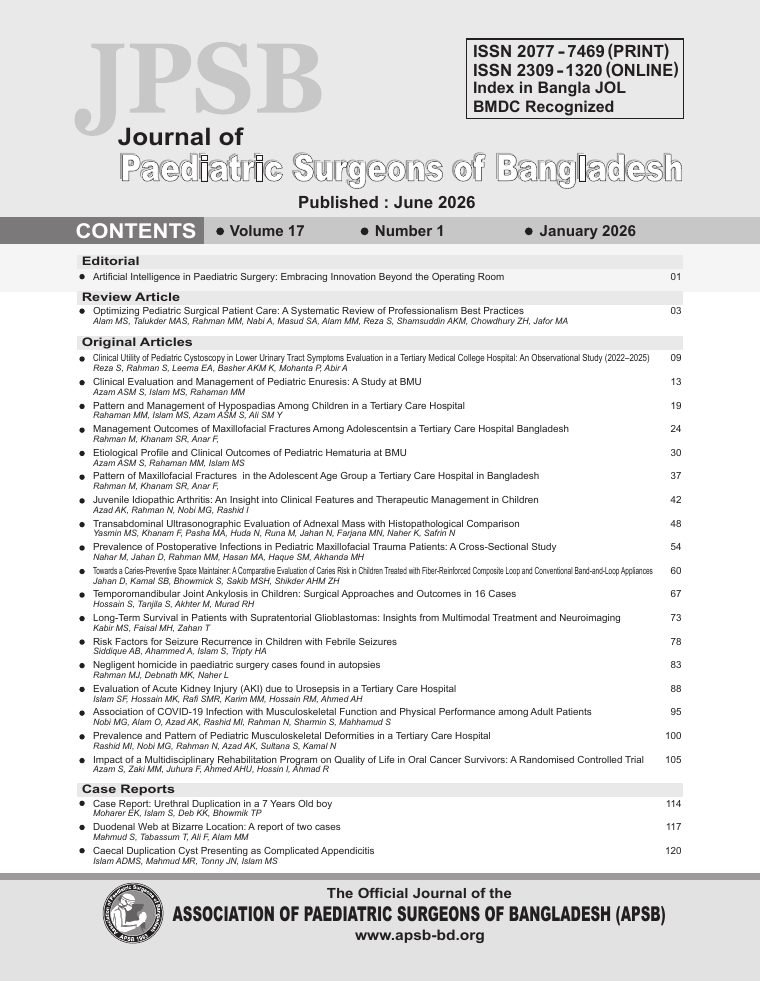
Risk Factors for Seizure Recurrence in Children with Febrile Seizures
Authors
Keywords
Abstract
Background: Febrile seizures happen in children between 6 months and 5 years with fever, impacting 2%–5%, and about one-third recur, typically within 1–2 years. They are categorized as either simple or complex. Recurrence is associated with factors like early onset age, family background, reduced fever intensity, and brief fever duration. This study seeks to pinpoint significant risk factors for recurrence to enhance management and guidance. Methods: This observational study conducted in a hospital involved 35 children between 6 months and 5 years who were clinically diagnosed with febrile seizures inthe department of Emergency, Observation & Referral, Bangladesh Shishu Hospital & Institute. Clinical, demographic, and laboratory data were analysed using SPSS v25.0 to determine predictors of recurrence, with ethical approval and informed consent secured. Results: Out of 35 children experiencing febrile seizures, 34.3% experienced a recurrence. Younger age (<2 years), a family history, brief fever duration (<24 hours), and multiple seizures occurring within 24 hours were significant predictors (p<0.05). Logistic regression indicated higher odds of recurrence for age under 2 years (OR=2.8), a family history (OR=3.5), fever lasting less than 24 hours (OR=2.9), and multiple seizures (OR=3.8), with hyponatremia demonstrating borderline significance. Conclusion: Recurrent febrile seizures were common and associated with younger age, a family history, brief fever duration, and several seizures occurring within a 24-hour period. There was also a connection to extended seizures and low sodium levels. These elements assist in evaluating risks and providing guidance, with additional extensive studies required for validation.
Journal of Paediatric Surgeons of Bangladesh (2026) Vol. 17 (1): 78–82